Zhivago’s escape from the partisan camp
Doctor ZhivagoYurii Zhivago’s escape from the partisan camp turns on a choice made after he hears that the Whites have been defeated but still cannot learn what has happened to the families. Rather than return to Liberius, he uses a cache prepared for this possibility and slips away into the taiga. The scene binds practical preparation to a private, remembered attachment: the Rowan tree that gives him a pretext at the sentry post also recalls Lara, and the escape ends with Zhivago leaving the camp alone beneath a full moon.
News Without Reassurance
In the dugout, the camp’s doctor challenges Liberius about what he knows of their people. Liberius reports that the civil war is over, Kolchak’s forces have been smashed, and the Red Army is driving east along the railway. Another part of the army is moving toward them to join forces against the remaining Whites in the rear. The news makes the military situation sound decisive, but it does not answer the personal question Zhivago immediately asks: where are their families?
Liberius presses him to be glad that the Whites have been driven back and points to sectors where they have been defeated. He reasons that they cannot be near Yuriatin: cut off from their communications, they would have to be captured. Zhivago agrees that the news is welcome, yet the certainty of the military report does not settle what he most needs to know. The gap between a campaign’s apparent conclusion and the absence of news about loved ones sharpens the scene’s central tension.
A Prepared Route Out
Zhivago leaves the dugout, saying that the smoke has given him a headache and that he wants air. Once outside, he begins to picture Tonia struggling through a blizzard with Sasha and another child, burdened with their care and without help. In this imagined scene he confronts the long absence of the children’s father, then thinks of Tonia’s father, Alexander Alexandrovich, and the others whose whereabouts he cannot establish. The thought moves from uncertainty about the families to the recognition that he cannot go back inside and resume his former course.
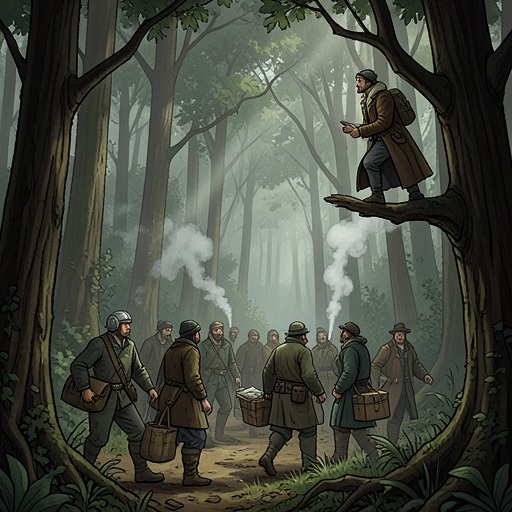
He changes his mind about returning to Liberius and heads for supplies he had hidden outside the camp long before. At the foot of a tall pine, marked with a notch so he could find it again, lie skis, biscuits, and other necessities for a possible escape. The cache gives the departure a concrete history: Zhivago had anticipated that a chance to leave might come, and had prepared for it in advance. On this clear, moonlit night, he follows the path between the snowdrifts toward the marked tree, at first keeping clear of the posted sentries.
The Password and the Rowan Tree
At a clearing, a sentry approaches on skis and orders Zhivago to halt, identify himself, and give the password. Zhivago identifies himself as the camp doctor, but the sentry, who addresses him as Comrade Zhelvak, insists that orders still apply. Zhivago supplies the password, “Red Siberia,” and the reply, “Down with the Interventionists.” The exchange briefly exposes the danger of his route: recognition alone does not authorize him to proceed.
Asked what he is doing out at night, Zhivago claims he was thirsty, could not sleep, and had come out for air and snow. He adds that he saw the rowan tree’s iced berries and wants to pick some. The sentry dismisses this as a gentleman’s eccentricity, remarking that years of trying to beat such nonsense out of people have not changed him, then lets him pass. Zhivago’s harmless explanation is a practical cover for continuing toward his hidden supplies.
Departure and Personal Meaning
The path brings Zhivago to the rowan tree he has just invoked as his excuse. He remembers Lara’s strong white arms and pulls the branches toward him; snow falls from them over him. Beside the tree, he speaks without realizing what he is saying, calling it his beauty, his love, and his own flesh and blood. The moment joins a remembered person to the landscape without making the tree a literal substitute for her: it is the point where the escape route, his longing, and his spontaneous speech briefly converge.
Zhivago then goes farther into the taiga, finds the pine marked with a notch, digs up the skis and provisions, and leaves the camp. The departure resolves the immediate action but not the uncertainty that prompted it. Liberius’s report has established that the Whites are being driven back; it has given Zhivago no news of the families. His escape is therefore both a carefully prepared physical departure and a break from a camp whose military account of events cannot answer his private need to find those who are missing.